A Win Against TAT But No Bad Faith Here
UK Trade Mark Opposition Decision Rules in Favour of Relative Grounds But Not on Bad...
Read more
On 4 December 2025, a decision was issued by the IPEC court (Dryrobe Limited v Caesr Group Limited (trading as D-Robe Outdoors [2025]) EWHC 3167 (IPEC), determining that the mark DRYROBE was infringed by Caesr Group Limited’s use of the sign D-ROBE. Caesr Group Limited was also found to have ‘passed off’ its goods as those of Dryrobe.
The case included an in-depth look into whether the term DRYROBE had become the generic term for a changing robe, ultimately concluding that it had not.
Dryrobe began manufacturing and selling goods under DRYROBE in 2011, with the Dryrobe Advance being introduced in 2012.
At the time, the ‘Dryrobe’ had been the first drying and waterproof changing robe on the UK market. The company remained the only UK retailer of the product until around 2018 or 2019, when third parties started entering the changing robe space.
Extensive marketing, including supplying Team GB for the 2016, 2022 and 2024 Olympics and Paralympics, and cultivating relationships with Red Bull, the RNLI and Surfing England, meant that the Dryrobe brand slowly became synonymous with a certain type of changing robe in the UK.
Popular with cold-water swimmers and outdoor enthusiasts, sales of the DRYROBE product took off in 2021, helped by the Covid lockdowns.
By 2024, in the words of the defendant, Caesr Group, Dryrobe was considered to be the ‘biggest player‘ in the outdoor changing robe market.

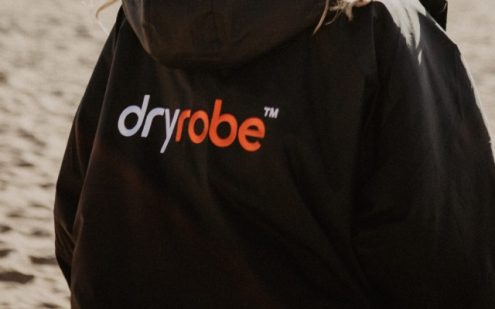
Dryrobe obtained UK trade mark registrations for the words DRYROBE and DRY ROBE, as well as variations of the stylised mark for the letters ‘dryrobe’ (shown above), with their earliest DRYROBE registration dating back to 2013.
The marks covered a range of goods and services in Classes 18, 25 and 35, including ‘robes’ ‘beach robes’ and the broad term ‘clothing’.
Following a dispute with Superdry in 2022, Dryrobe changed their logo to the stylised logo above, although the visual rebrand apparently went unnoticed by consumers.
The DRYROBE mark featured prominently on the back of the goods, to the extent that the judge described the design of the changing robe as looking almost like a ‘walking billboard’.
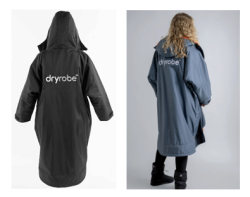
Caesr Group registered the domain name ‘d-robeoutdoors.com’ in February 2021 and developed the D-Robe branding (below):


In 2022, they started trading using the above signs in relation to changing robes.
During the development of the D-Robe brand, the director of Caesr Group was warned by her branding agency that the Dryrobe brand could be a potential legal issue with regard to the ongoing use of D-ROBE.
Despite this warning, Caesr Group continued with the D-ROBE brand and started trading in the UK in 2022.
Dryrobe Limited brought High Court proceedings against Caesr Group claiming trade mark infringement pursuant to Sections 10(2) and 10(3) of the Trade Marks Act 1994 as well as passing off.
Caesr Group denied infringement, although it dropped its defence under Section 11(2)(b)) and denied passing off.
It filed a counterclaim, alleging that the mark DRYROBE had been invalidly registered under Sections 3(1)(b) TMA 1994 (that the the sign ‘DRYROBE’ was devoid of any distinctive character), Section 3(1)(c) (that the sign DRYROBE was descriptive of the goods) and Section 3(1)(d) (that the sign DRYROBE had become customary/generic).
In addition, Caesr Group sought revocation of the DRYROBE marks under Section 46(1)(c) (alleging the DRYROBE marks had become the common name in the trade and were generic) as well as seeking partial revocation of the DRYROBE marks under Section 46(1)(a) for a sub-set of the goods/services for which it was registered.
An interesting feature of this judgment is the Court’s detailed treatment of D-Robe’s validity and revocation counterclaims, which required it to distinguish between (i) descriptiveness and (ii) generic/customary use.
Caesr Group argued that at the date Dryrobe filed their trade mark applications for DRYROBE, the word was not functioning as an indicator of trade origin but had become the commonly accepted way to describe the category of goods (the category being a changing robe), rather than as a brand name.
This was advanced both as a descriptiveness objection (Section 3(1)(c)) and as a case that the sign had become customary in the current language or established practices of the trade (Section 3(1)(d)).
In other words, the issue was not merely whether DRYROBE was suggestive of a characteristic of the goods, but whether it had already become generic at the dates on which the DRYROBE marks were filed.
The Court approached this issue registration by registration, considering the position at the date each application was filed:
UK00003001195 DRYROBE – 9th April 2013
UK00918088428 DRYROBE – 28th June 2019
UK00003751826 (various stylised ‘dryrobe’ word marks – 7th February 2022
UK0003855456 DRYROBE / DRY ROBE – 2nd December 2022
The Court asked whether, at each relevant filing date, DRYROBE was descriptive (Section 3(1)(c)) or customary in the trade (Section 3(1)(d)), and if so, whether acquired distinctiveness had been established.
If DRYROBE was not generic at the date the applications were filed, Caesr Group argued that at the date they filed their counterclaim on 11th November 2024, DRYROBE had by then become the common name in the trade for changing robes (Section 46(1)(c)). This is not the same issue as validity at the date filing, but rather, focuses on whether the mark had lost its function as an indicator of origin as a result of market use.
Caesr Group tried to prove that DRYROBE was a generic term by submitting evidence from the press, social media and competitor websites showing that people were using ‘dryrobe’ as a general descriptor of the product category.
They also tried to rely on Dryrobe’s own enforcement activity, where in some instances, having contacted people on social media to ask them to stop using the word ‘dryrobe’ descriptively, people had replied to Dryrobe to say they thought ‘dryrobe’ was the generic term for a dry robe. Caesr Group argued that this was indicative of consumer perception.
Dryrobe’s evidence was that it had been alert, from around 2019, to the possibility of their mark DRYROBE becoming the generic term for a changing robe.
Not wanting their brand to go the same way as other brands that have been affected by genericide, they developed a comprehensive strategy to try to prevent the mark DRYROBE from becoming generic and falling into the public domain.
The strategy included taking the following series of actions:
It was held by the Court that the DRYROBE mark was found to be descriptive of ‘Changing robes; waterproof and windproof robes; robes, gowns and capes of towelling material; beach wraps; clothing; waterproof clothing; sports clothing’ in Class 25 on the basis that DRYROBE describes a robe which dries or keeps the wearer dry.
The mark was not considered descriptive for bags (Class 18) or hats/beanies (Class 25).
Crucially though, despite the DRYROBE mark being held descriptive for the relevant robe/clothing terms, it was considered to have a ‘medium to high degree’ of acquired distinctive character at the relevant date for the assessment of infringement, namely March 2022. The intensive use of DRYOBE in the marketplace meant that consumers could attach trade mark significance to it, the finding of descriptiveness notwithstanding.
On similarity, it was no surprise that the Court found D-ROBE and DRYROBE to have a high degree of visual similarity and a medium degree of aural and conceptual similarity.
Despite the common element ROBE having been considered descriptive, the Court found that the hyphen in the D-ROBE mark was likely to be perceived by the average consumer as replacing the letter ‘RY’ in DRYROBE, strengthening the likelihood of confusion.
It was common ground between the parties that the marks were being used on identical goods.
The overall level of similarity between DRYROBE and the logo above was assessed as ‘low to medium’, but the Court nevertheless found a (lower) likelihood of confusion, confirmed by extensive evidence of actual confusion (direct, indirect and ‘wrong-way’).
Evidence pointing to actual consumer confusion was submitted by Dryrobe, such as when consumers contacted Dryrobe seeking to return or exchange D-Robe products. Evidence of indirect confusion was also provided, including an instance where a consumer contacted Dryrobe to ask ‘dryrobe…so D-Robe is that not you?’
The Court held that the Dryrobe marks were infringed under Section 10(2) by the Defendant’s use of the D-ROBE sign and the logo above. The section 10(2) (likelihood of confusion) claim succeeded.
Regarding infringement under Section 10(3), the Court found that the DRYROBE marks already had the requisite reputation in the UK by 1st March 2022, when D-Robe began trading.
It further held that the Defendant’s use of D-ROBE would cause the relevant public to make the necessary ‘link’ with DRYROBE and that the defendant thereby had taken unfair advantage of the distinctive character or repute of the DRYROBE marks.
The Court was satisfied there was the required likelihood of a change in economic behaviour and found evidence of actual change, including consumers purchasing D-Robe goods believing them to be Dryrobe goods. With that, there was ‘no due cause’ and the Section 10(3) claim therefore succeeded.
In so far as passing off, all three elements were made out successfully (goodwill, misrepresentation and damage) and Dryrobe’s claim on this strand succeeded.
Turning to the counterclaims, the invalidation actions under Sections 3(1) (b), (c), and (d) all failed.
The marks were held to be validly registered and the Court was not satisfied that DRYROBE had become the common name in the trade for a changing robe by the date the counterclaim was filed, namely, November 2024.
D-Robe had sought revocation of one of the Dryrobe marks on the grounds of non-use.
Dryrobe admitted non-use in relation to certain goods, and removed them from the specification. The Court found no genuine use of DRYROBE in relation to the Class 16 goods ‘Gift cards; cardboard gift boxes; printed matter; gift bags; paper bags; newsletters; stickers; decals; stationery’, the Class 25 goods ‘beach shoes’ and the corresponding Class 35 services.
The Court ordered the removal of these goods and services from the specification; beyond that reduction, the Court dismissed the Section 46(1)(a) revocation counterclaim.
This case emphasises the importance of taking proactive steps to ensure that your trade mark does not become a generic name for a product.
Dryrobe was able to show it had engaged in a structured ‘anti-genericism’ program, including consumer-facing guidance on correct use of Dryrobe, ‘no substitutes’ messaging, regular monitoring and enforcement activity, and a maintained log of third-party contacts.
The judge considered this as evidence that Dryrobe had demonstrated sustained efforts to preserve the distinctiveness of their mark.
When facing any case like this, it is crucial to show that substantial efforts are made to police the mark and encourage correct usage. Had Dryrobe not undertaken this, our view is that they would have lost this case and possibly their DRYROBE brand altogether.
The decision also provides a useful insight into the assessment of similarity: the judge considered D-ROBE to be visually suggestive of ‘DRYROBE with the ‘RY’ removed or replaced’ (the hyphen representing the missing letters), while dismissing the argument that consumers would naturally read D-ROBE as meaning ‘to take off a robe’, noting that ‘disrobing’ is the more usual everyday expression.
If you need help in this area, tap into our expertise, contact SH&P and find out how we can help you.
Posted: 13th April 2026