Lifestyle Equities CV v Amazon UK Services Ltd – Territorial Trade Mark Boundaries Must Apply To Online Retailers
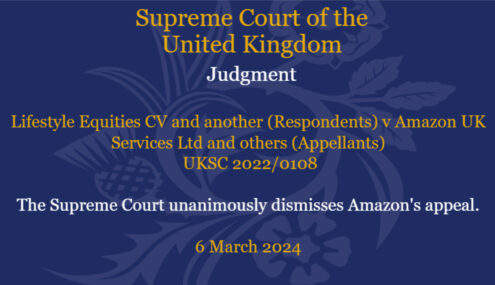
On 6th March 2024, the giant retail platform Amazon was defeated by a Supreme...
Read more
The internet does not recognise national borders, but intellectual property rights do.
That simple conflict lies behind two recent cases before the Court of Justice of the European Union (CJEU), both of which examine how businesses can control access to online content and services using a technique known as ‘geo-blocking’.
One case concerns the copyright inherent in ‘Anne Frank’s diary’ and the other focuses on an Austrian trade mark dispute involving the name PAUSCHA.
Together, these cases raise an important question: if a website is accessible worldwide, how can rights that are limited to specific countries be properly protected?
Geo-blocking is the practice of restricting access to a website or online content based on a user’s location.
Most commonly, a website identifies where a visitor is located by looking at their IP address. The site can then either allow access or block it depending on the country from which the user is connecting.
Most people encounter geo-blocking through streaming platforms. A television programme available in one country may not be available in another. The same principle can apply to websites displaying copyrighted material and selling branded products.
For intellectual property owners, geo-blocking can act as a way of creating digital borders around rights that are territorial by nature.
Trade marks and copyright often operate differently from country to country.
A German trade mark registration only gives rights in Germany. Similarly, a UK trade mark registration only gives rights in the United Kingdom.
Copyright can also differ between countries. A work may have entered the public domain in one country while remaining protected in another.
In the context of the internet and its global nature by default, the challenge to intellectual property then becomes obvious. A website can be accessed globally, yet the rights being enforced may only exist in certain territories.
Geo-blocking has become one of the main tools businesses use to bridge that gap.
A recent CJEU decision concerned an academic edition of Anne Frank’s diary and manuscripts.
The diary remains protected as a literary work by copyright in the Netherlands until 2037. However, in several other countries, including Belgium, the copyright has already expired and the works are in the public domain.
A Dutch academy and Belgian association published the material online free of charge and, mindful of the copyright protection still in force in the Netherlands, the publisher used geo-blocking technology to prevent anyone with an IP address in the Netherlands from accessing the website.
The Anne Frank Fund, which owns the Dutch copyright, argued this was not sufficient. It pointed out that users could still access the website through a VPN or similar technology designed to disguise their location.
In simple terms, the rights holder’s argument was:
‘If someone in the Netherlands can still access the material using a VPN, the geo-blocking is not really working’.
The CJEU disagreed.
The Court held that the mere possibility of circumventing geo-blocking does not automatically make the measure ineffective. If a publisher has implemented modern and effective geo-blocking technology, it does not have to guarantee that circumvention is impossible.
That is an important and practical conclusion.
We can use a simple analogy to apply the same logic. A nightclub checks age identification before allowing entry. A determined teenager may still manage to gain access using a fake ID. That does not mean the nightclub failed entirely in its obligations.
Similarly, the Court recognised that no technological measure can provide perfect protection. The law requires reasonable and effective safeguards, but it does not (and probably cannot) demand absolute certainty.
For copyright owners and publishers, the decision provides welcome clarity. Effective geo-blocking may be sufficient to prevent liability, even where determined users can find ways around it. Not only does it signal a publisher’s respect of copyright law, it also demonstrates intent and a practical step taken by the publisher to address any such issue from the outset.
The second case, currently awaiting a decision from the CJEU, concerns trade marks rather than copyright.
The dispute involves two Austrian cooperage businesses.
One company owns Austrian trade mark registrations for PAUSCHA and KLAUS PAUSCHA covering barrels and related goods and services.
Following earlier proceedings, the defendant was restrained from using the sign PAUSCHA in Austria.
The defendant then took steps to avoid targeting Austrian consumers. It geo-blocked Austrian IP addresses from accessing its website and added a disclaimer stating that the site was not intended for Austrian customers.
At first glance, that seems a sensible workaround. If Austrian consumers cannot access the website, the trade mark is not exposed to them and they cannot buy products from the defendant, meaning the defendant is no longer a business competitor in that country.
However, the trade mark owner was not satisfied by this.
It argued the defendant was still using the sign PAUSCHA in its domain name and email addresses. As a result, it sought broader restrictions extending beyond Austria.
Given the potential ramifications of the decision, this led the Austrian Supreme Court to ask the CJEU for guidance.
The key question is simple and it can be boiled down to this:
Two competing principles are at play here.
The first is territorial.
Trade mark rights are generally limited to the country in which they are registered. Austrian trade mark rights protect Austria, not the rest of the world.
The second is the global nature of the internet.
A website exists online regardless of where visitors are located. Even when access is restricted, the site itself still exists.
The challenge for the CJEU is determining how these principles should interact.
One of the issues likely to influence the Court’s thinking is an earlier CJEU decision, L’Oréal v eBay.
That case established that online activity generally infringes a trade mark only when it is directed at consumers within the territory protected by the trade mark.
Examples of targeting might include:
The PAUSCHA dispute raises the reverse situation.
The defendant has attempted to do the opposite. It has blocked Austrian users and included a disclaimer stating that Austrian customers are not being targeted.
That naturally raises the question: if a business is actively trying not to target a particular country, can trade mark infringement still occur there?
Logically, it would seem that the answer has to be that there can be no trade mark infringement if there is clear intent by a seller not to expose its products to a particular market and that it has taken practical steps to try and ensure this, as far as it can do so.
The Anne Frank case suggests that effective geo-blocking can play a valuable role in managing intellectual property risks online.
However, the pending PAUSCHA decision demonstrates that geo-blocking may not always provide a complete solution.
Copyright and trade mark law protect different interests and operate under different legal principles.
In the copyright context, the CJEU has already indicated a willingness to accept practical (but not perfect) technological solutions.
Whether it will adopt a similar approach for trade marks remains to be seen.
The eventual judgment could have significant implications for businesses that operate internationally. It may clarify whether geo-blocking and clear disclaimers are enough to avoid trade mark infringement claims, or whether the continued use of a sign within a domain name can itself create liability even where access to the underlying website is restricted.
The internet was built without borders. Intellectual property rights were not.
Geo-blocking has emerged as one of the principal tools for reconciling those two realities. The Anne Frank decision confirms that effective geo-blocking can, in some circumstances, prevent copyright infringement even where determined users can bypass restrictions using VPNs.
The PAUSCHA case now asks whether the same practical logic should apply to trade marks.
In the digital environment, the principle of territoriality requires a practical and realistic assessment.
If a trader uses technical and commercial measures to show a genuine intention not to sell products or services in a particular territory, a website viewable outside that territory should not, on its own, amount to use of the sign within the country protected by the national trade mark.
The law must recognise the distinction between a trader who seeks to reach consumers within a territory and one who has taken reasonable steps to avoid doing so. Those reasonable steps should consist of:
It will be interesting to see if the CJEU arrives at a similar position.
Posted: 4th September 2026


On 6th March 2024, the giant retail platform Amazon was defeated by a Supreme...
Read more

Trade Mark Hijacking Now a Feature in Russian Trade Mark Practice - Many Big Western...
Read more